
Behind The Scenes: Taking A Trip To The Moon
I’m so grateful to have you as a member of The Industry’s Insider program! Thank you so much for your sustaining support, which goes so far to keep our doors open and engines running!
In addition to supporting us, we have member perks like this message: an exclusive look at our company’s work both inside and outside The Industry. In this message, I’m going to give you a look at TRIP TO THE MOON, my newest production for LA Phil, which was performed Friday and Saturday.
A lot of people wonder why, if The Industry is so successful, I would need to take on other projects outside the company. For one, I think you can compare directing with speaking a foreign language: you need to practice it with regularity to truly make progress on your ability. With one project following another, I get to stay in a creative flow that I think really helped me make significant strides practicing and refining my craft over the last few years.
Secondly, directing at other companies and under other circumstances gives me an opportunity to stay up-to-date with current trends, best practices, and the best practitioners in the field. All that experience goes directly into planning and preparing The Industry’s next moves.
Finally, they offer me the pleasure of concentrating on only on skill: I only have to wear my director’s hat, not manage the multiple ones I need to wear for The Industry’s projects. The back-and-forth between established institutions and this young, rebellious one are actually complementary experiences, and I believe both results are richer because of their interdependence.
The LA Phil relationship is particularly special because it offers me a chance to unify the two strands of my creative output — right in my home city. Three of my projects with the LA Phil have been co-productions with The Industry — most notably WAR OF THE WORLDS, and our upcoming collaboration on John Cage’s EUROPERAS. Two projects this season are not collaborations with The Industry: a staging of Mahler’s DAS LIED VON DER ERDE in April, and Andrew Norman’s new children’s opera, A TRIP TO THE MOON.
Andrew may be familiar to you as one of the most prominent composers of his generation — a recent winner of the prestigious Grawemeyer Award, among his many honors and accolades. But HOPSCOTCH fans may recognize him as one of the six composers that collaborated on that project: he created the hypnotic Finale at the Central Hub, as well as three intimate chapters along the routes.
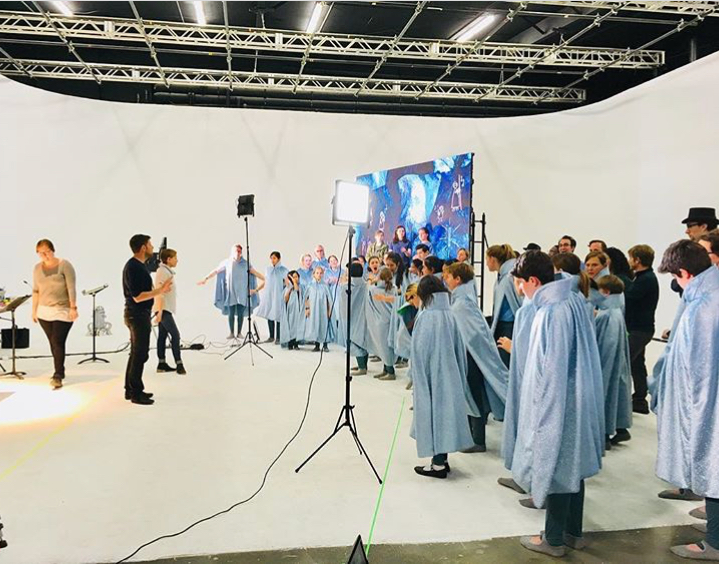
This is Andrew’s first foray into more conventional opera — and, as you can expect, it’s hardly conventional at all! It’s written for a large orchestra — a great thing, since to my mind his orchestrations are endlessly fascinating and magical — ten soloists, 100 children, and an adult chorus. Half of the opera is in an invented language –“Moonish” — to tell a kind of elemental fable of encountering difference with empathy and joy.
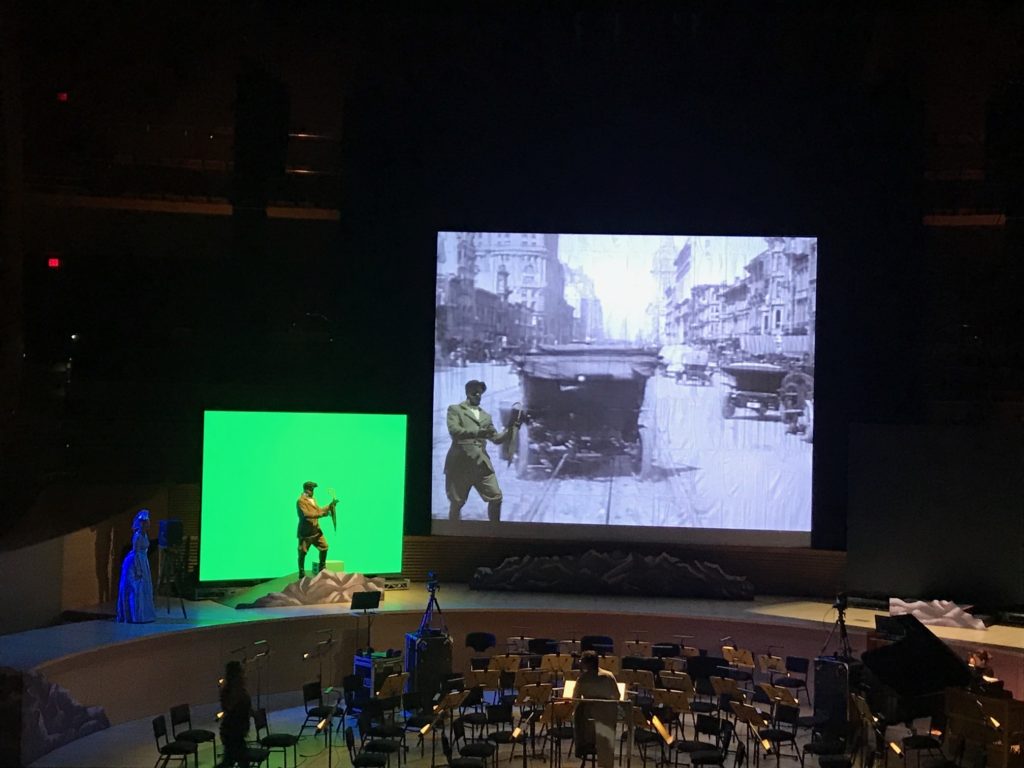
Andrew took Georges Melies’s wondrous film “Voyage to the Moon” as his launching pad to depict the meeting of human astronomers and the creatures of the moon. In the Melies film, the astronomers arrive and immediately start terrorizing the reptilian inhabitants of the moon. Andrew, instead, shows the two species overcoming their fears of difference and solving each other’s problems. The astronomers need the Moon People’s help to repair their rocket and return home; and the Moon People need the astronomer’s help in battling a mysterious monster that is kidnapping their children.
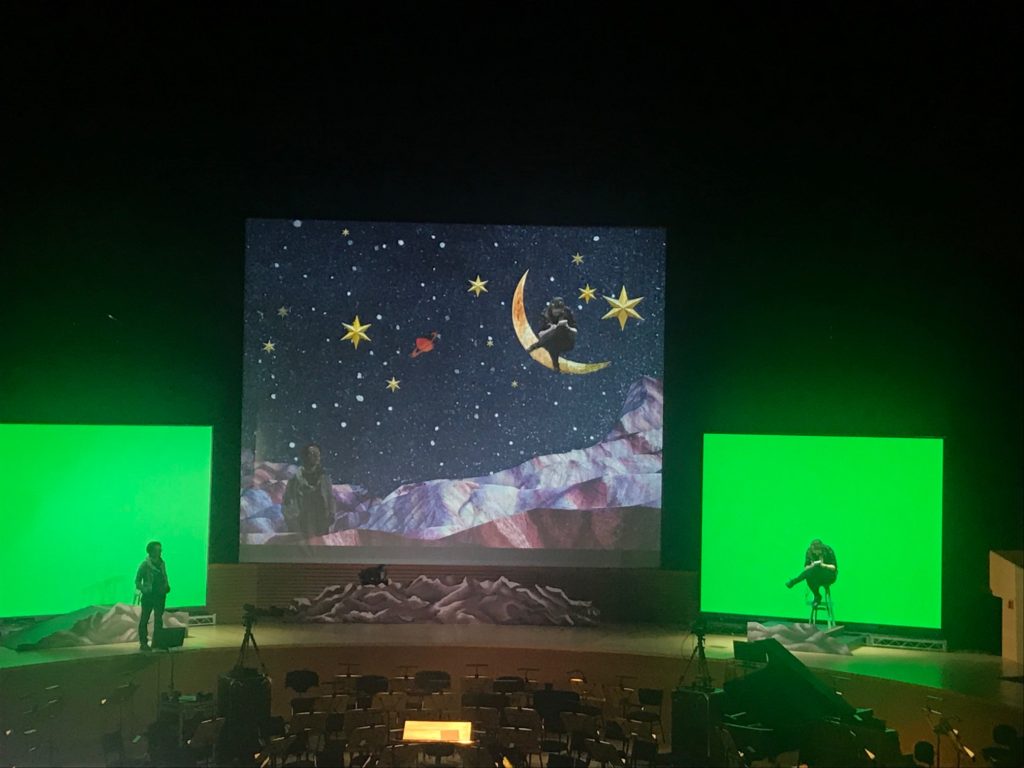
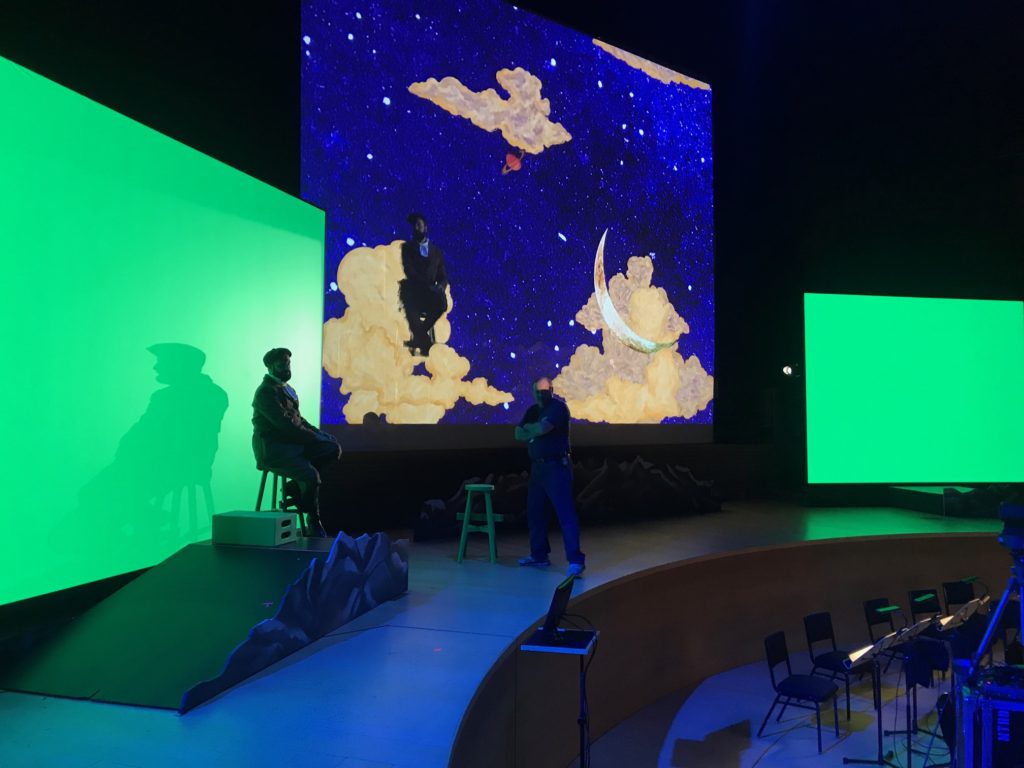
My production concept centers around “green screen” technology, which allows us to put our singers and actors “inside” Melies’s film. It is delightful to watch, but to me, exposing the artifice of the fabricated stage world — showing both the two-dimensional image and the three dimensional actors creating the illusion — has thematic significance. The first time a human interacts with a moon creature, the two singers are on opposite sides of the stage, in front of different green screens. But in the central image (what we call “the composite picture”) they are side by side, almost holding hands. I find this interplay of distance and an aspirational closeness so touching, and so true: all it takes to come together with someone who seems different or distant from us is a (relatively small) leap of the imagination. There is an ideal image of togetherness, which our material world may not yet support, but which exists as a kind of imagined future, a realm of potentiality that exists within us.
The creative joy in the music and (hopefully) in the production should draw the audience in to a space that lets them ponder the meaning of dialogue, togetherness, and diversity. In this way, the abstraction of the fairy tale story allows us to address truly crucial social problems.
I hope you enjoyed the performances this weekend!